WritersForge
‹ Back to WritersForge

A little experiment

We tried to trick StoryEdit.
It read right through us.

So we fed it 17 unrelated stories — twelve of them untitled, none of them connected — mashed into one 162,000-word document, and asked it to make sense of the mess.

17
unrelated stories
162,516
words, one file
12
pasted in untitled
3m 4s
upload → Story Bible*

The setup

The diabolical plan

Manuscript import is supposed to take a novel and build a Story Bible from it. So we asked the cruel question: what if the "manuscript" isn't a novel at all — just chaos wearing a novel's clothes?

What we actually uploaded

The only thread holding any of it together was that Poe writes like Poe. The five originals had nothing in common but a byline. There was no plot to find, because there was no plot. We wanted to watch it fail — or better, watch what it did instead.

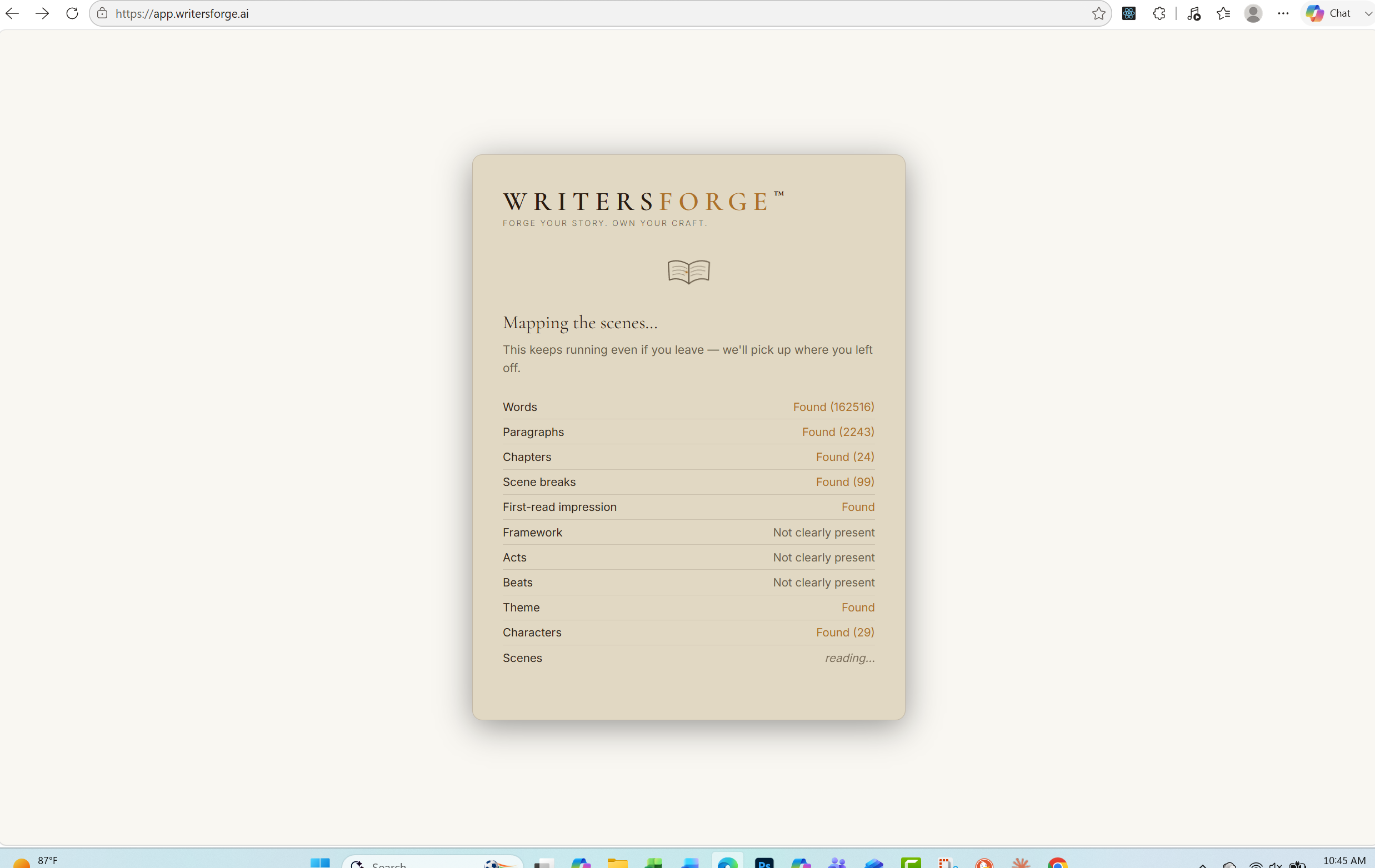
WritersForge mapping the manuscript: framework, acts and beats not clearly present; theme found; 29 characters

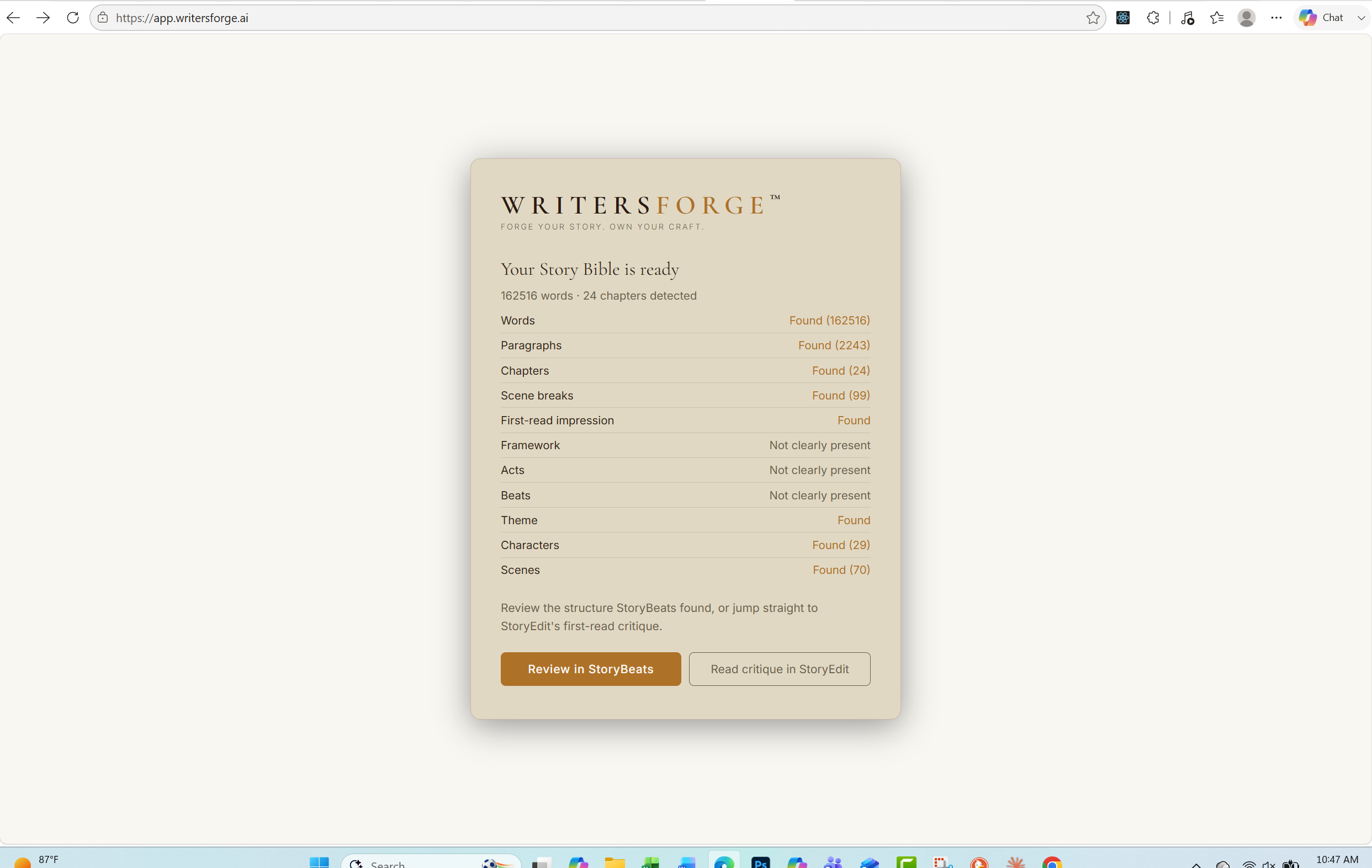
162,516 words. And look at the honest part: framework, acts, and beats came back “not clearly present” — because they aren't. It refused to invent a structure that wasn't there. Yet it still found a theme and 29 characters.

Story Bible ready: 162,516 words, 24 chapters detected, 70 scenes

Minutes later: a full Story Bible — 24 chapters, 70 scenes, a theme, a character list — built out of a document that had no business being a single book.

Recognition

Then it named every one.

We asked StoryEdit to list any stories it recognized. It identified all twelve Poe works — by correct title and year — and counted the collection exactly.

The twelve Poe works it identified

From an unlabeled wall of text, with titles it was never given.

The Fall of the House of Usher · 1839
The Murders in the Rue Morgue · 1841
The Purloined Letter · 1844
The Gold-Bug · 1843
A Descent into the Maelström · 1841
The Facts in the Case of M. Valdemar · 1845
Hop-Frog · 1849
The Pit and the Pendulum · 1842
The Cask of Amontillado · 1846
The Black Cat · 1843
The Masque of the Red Death · 1842
The Narrative of Arthur Gordon Pym · 1838

…plus it correctly separated out the five original pieces — “Finn and Oliver,” “A Good One,” “The Great Elite,” “Threads,” and “A Cold Day” — for a total it stated plainly: 17 pieces.

And then it caught something we didn't plan.

One Poe story — “The Mystery of Marie Rogêt” — is mentioned in passing inside another tale but never actually included in the document. StoryEdit noticed, and said so:

StoryEdit · First Reader
“I do not see ‘The Mystery of Marie Rogêt’ represented as scenes, though it is mentioned briefly in passing during the Purloined Letter setup. It's referenced but not included.”

It didn't just read the stories that were there. It noticed a story that wasn't.
The honest read

Its first-read impression

Then we asked for a critique — the same first read StoryEdit gives any manuscript. It correctly treated the whole thing as an anthology, found the genuine thread running through it, and gave real, specific editorial notes on the original work.

StoryEdit · First Reader · first-read impression
“As an anthology, the collection lacks a governing architecture… The thematic spine — consciousness trapped by environment, struggling toward revelation or annihilation — is genuinely present across the material, but the reader is never invited to perceive it.”
“‘A Cold Day’ is the strongest piece in the collection and deserves serious development as a standalone work.”
“‘Finn and Oliver’ has the strongest structural bones of the five… but it ends at the wrong moment. The story earns its ending and then doesn't deliver it.”
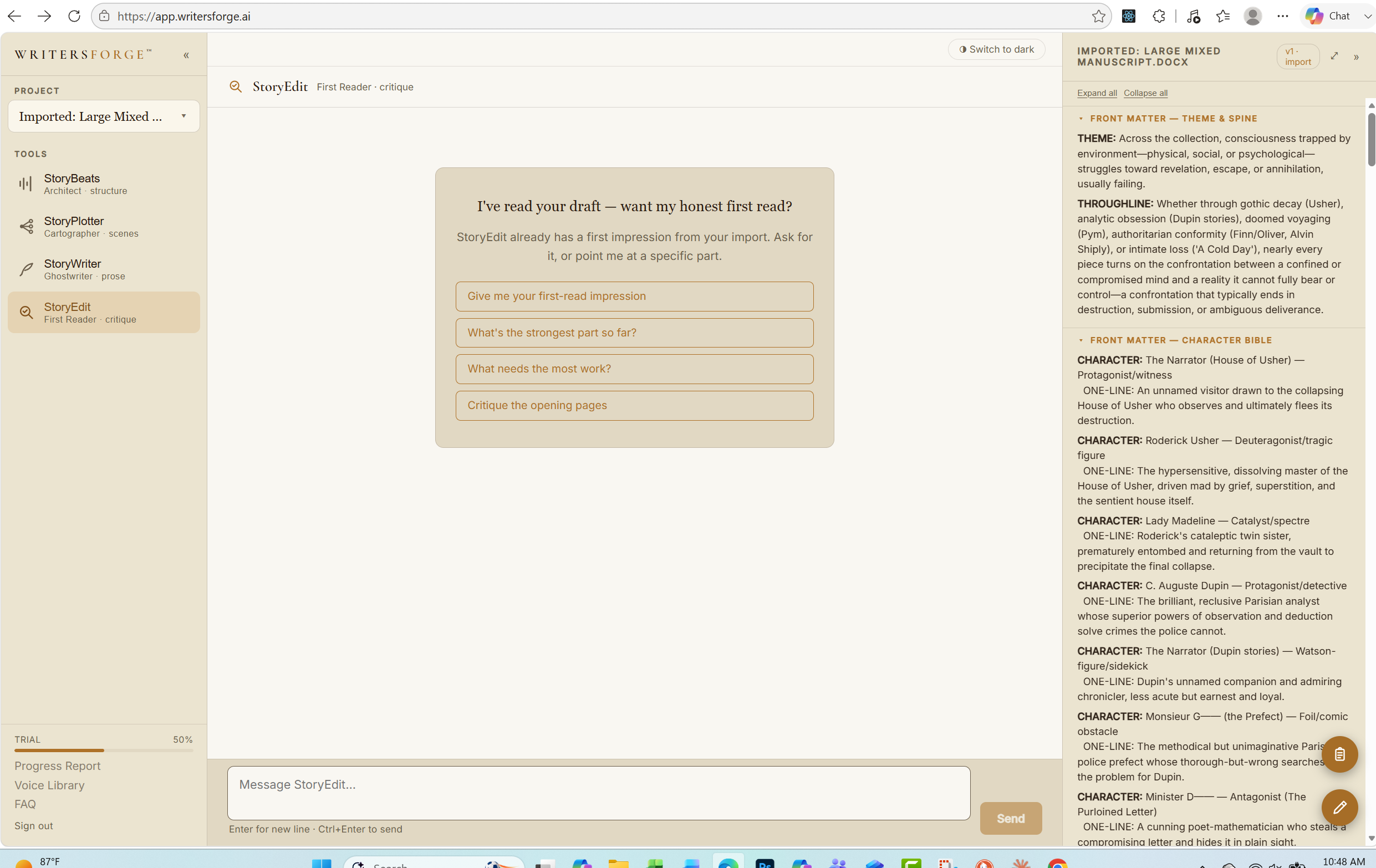
StoryEdit with the Story Bible: theme and throughline naming Usher, Dupin, Pym and the original pieces

The Story Bible it built — a real theme and throughline that names Usher, Dupin, Pym, and the originals by name. It found the one honest thread in a document designed to have none.

Why this is more than a party trick

Your real manuscript is never as clean as a demo. It has half-finished threads, a subplot that wandered off, two chapters that don't belong. We threw the worst-case document at StoryEdit because your actual draft is a gentler version of the same problem. If it can find the structure — and the honest gaps — in seventeen stranger stories glued together, it can tell you what's really going on in yours.

We tried to trick it. It just did its job.

Bring us your messiest draft.

WritersForge reads what you've actually written — however tangled — and gives you an honest, structured read. Bring yours and see what it finds.

Enter the Forge

Your manuscript is yours. Nothing you upload trains any model, and nobody reads it but you.